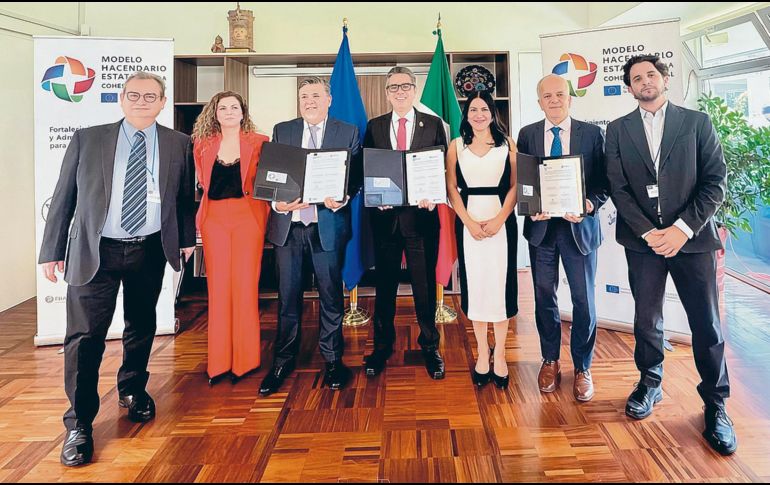
In an unprecedented move in the country, the governments of Jalisco and Guanajuato signed a collaboration agreement that will strengthen road safety, improve tax coordination, and combat tax evasion between the two states.
This is the Agreement for Administrative Collaboration and Coordination in Tax Matters and Interstate Mutual Assistance, an instrument that is already in effect and being implemented, and which establishes a new model of cooperation between states.
What does the agreement between Jalisco and Guanajuato entail?
This agreement sets a national precedent as the first of its kind, laying the groundwork for other states to join a similar scheme of administrative and tax coordination.

With its implementation, vehicles with Guanajuato license plates circulating in Jalisco must comply with their traffic regulations and, in the event of violations, may be sanctioned and notified in their state of origin. The measure will also apply reciprocally to vehicles with Jalisco license plates traveling in Guanajuato.
The goal is to ensure the equitable application of the law and prevent drivers from evading responsibility by traveling between states.
During the signing of the agreement, the Secretary of Public Finance of Jalisco, Luis García Sotelo, highlighted the prior work that made this agreement possible. “The agreement we are formalizing today between Jalisco and Guanajuato is the result of prior work, of technical dialogue between our administrations. In the realm of public finance, solid agreements are built on institutional trust, information sharing, and shared political will,” he stated.
The agreement also includes the exchange of information through digital platforms, which will strengthen the vehicle registry, improve the identification of violators, and increase the efficiency of tax collection.
What benefits are expected from this agreement between Jalisco and Guanajuato?
Among the benefits are increased debt recovery, greater efficiency in enforcing fines, and a strengthened culture of traffic law compliance by ensuring that violations have real consequences.
The process received technical support from the Ministry of Finance and Public Credit, the European Union in Mexico, and the National Commission of Tax Officials, reinforcing its strategic nature.
With this initiative, Jalisco positions itself at the forefront of interstate tax coordination by promoting an innovative model that could be replicated in other states.
Collection of vehicle debts and fines between Jalisco and Guanajuato, regardless of where the vehicle is registered.
Interstate tax coordination to improve compliance with vehicle regulations.
Reduction in penalty evasion by preventing drivers from avoiding fines by driving in another state.
Reciprocal application of the law for vehicles in both states.
Exchange of information through digital platforms to strengthen the vehicle registry. More efficient identification of offenders and follow-up on penalties.
Improved public revenue collection through more effective collection mechanisms.
Strengthening of a culture of road safety, ensuring real consequences for violations. A model replicable nationwide for other states.
Fixers sell out-of-state license plates to avoid traffic fines.
In Mexico, the irregular sale of vehicle license plates from other states—through intermediaries known as “fixers”—has become a common way to evade traffic fines and tax obligations.
According to testimonies, these intermediaries operate primarily on social media, where they offer to process license plate changes in a matter of days. The service allows drivers to drive with out-of-state plates, making it difficult to enforce penalties, especially traffic camera violations or local infractions.
The costs vary depending on the state of origin: they can range from about three thousand to seven thousand pesos, depending on the state and the ease of processing offered.
This practice has spread in metropolitan areas like Mexico City, where authorities have even acknowledged that a significant proportion of vehicles bear license plates from other states, complicating vehicle control and facilitating tax evasion.
In addition to the fiscal impact, authorities warn that the phenomenon also affects road safety, as some drivers use these plates to avoid speeding tickets detected by cameras.
In response, various levels of government have begun implementing reforms and operations to standardize vehicle registrations and limit these practices.
Source: informador