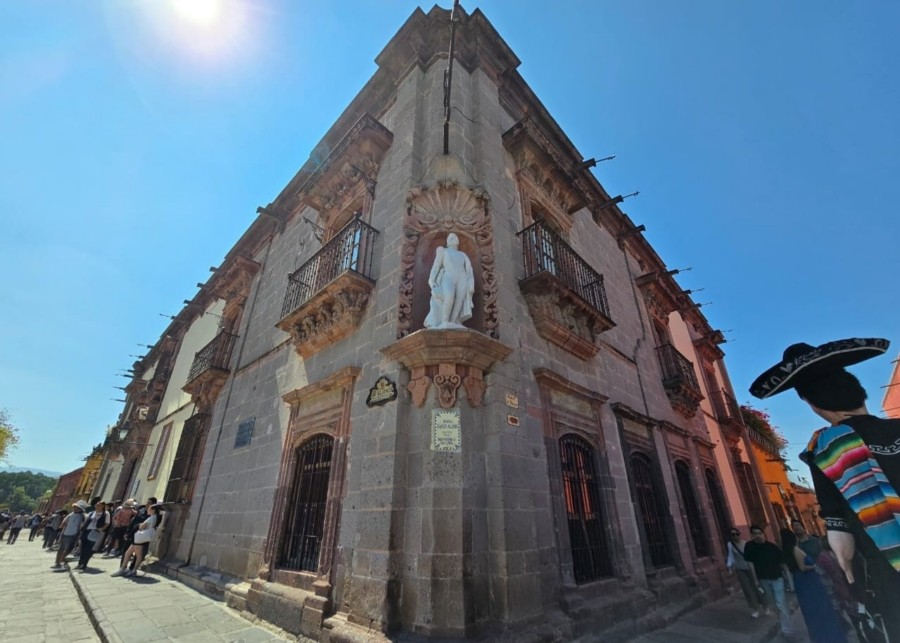
The Casa de Allende Historical Museum offers a journey through the history of San Miguel el Grande, now San Miguel de Allende, Guanajuato, between the 16th and 18th centuries. On your next visit to this UNESCO World Heritage city, witness the daily life of the Allende family, immerse yourself in the origins of Mexican Independence, and learn about the life of one of its key figures.
Before becoming one of the most beautiful destinations in the country, San Miguel was known as San Miguel el Grande. It was a strategic point in New Spain, as its location facilitated trade and, at the same time, the exchange of ideas. In this environment, Enlightenment ideas began to circulate, challenging the rule of the Spanish peninsulars.
The museum guides visitors from this initial context: daily life in the 18th century, the trades, the social dynamics, and the tensions that gradually ignited the desire for change. Here, it becomes clear that Independence did not arise from nothing, but from a society that was already transforming.
This two-story house was the birthplace of Ignacio Allende, a key figure in the insurgent movement. It was built around 1764 as a wedding gift from Domingo Narciso de Allende, Ignacio’s father, who, along with his mother, Ana María de Unzaga, established a wealthy Creole family. Ignacio was the fifth of seven children, all within a context marked by the Bourbon Reforms, whose high taxes generated growing social discontent.

Today, its rooms meticulously recreate life from that era: from the main hall and bedrooms with chests, screens, and mirrors to the kitchen where wood-burning stoves were the norm and where cooks would search for embers—hot coals—to rekindle the fire. There is also the oratory where the Allende couple displayed their devotion to Saint Ignatius of Loyola. Each space reveals how a New Spain elite lived… and how, from within that very environment, ideas of rebellion began to emerge.
Houses always have special spaces, and this case was no exception. In the mansions of that time, there was a family room and a “deckroom.” The latter was used for social gatherings, where guests danced, sang, played cards, and discussed political and cultural matters. From 1808, Allende and other “conspirators” organized the “secret meeting of San Miguel el Grande,” which was attended by around sixty people, creating a “rebellious village” led by Allende himself. The rest is history.
In 1810, with the outbreak of the War of Independence, Allende became one of the main insurgent leaders. During the war, the house was confiscated by the viceregal government; after the conflict ended, it was returned to his sisters and later sold to private individuals.
In the 20th century, the property was acquired by the government of Guanajuato in 1976 and ceded to the National Institute of Anthropology and History (INAH) in 1984 for its transformation into a museum. It was finally inaugurated in February 1990. In 2008, the building underwent architectural and museographic restoration, becoming the first INAH museum to be restructured as part of the preparations for the Bicentennial of Independence in 2010.
Within the Casa de Allende Historical Museum is the Izcuinapan Room, which displays 135 pieces that reveal the region’s rich pre-Hispanic heritage. Among them are ceramic objects, obsidian and blue-green stone tools, delicate necklaces made with shells, as well as hunting implements and everyday utensils. All these remains come from important archaeological sites such as Cruz del Palmar, Tierra Blanca and the renowned Cañada de la Virgen Archaeological Zone, among others.
It is worth noting that in 2022 the museum received over two thousand pieces for the safekeeping, conservation, and exhibition of the collection of historian, genealogist, archaeologist, professor, politician, and cultural promoter Miguel Malo Zozaya. This collection, comprised of stones, pipes, and pottery shards, serves as a reminder that Mexico’s history begins with ancient civilizations whose traditions and symbolism continue to resonate in the region.
The museum is located on one of the most emblematic corners of the historic center, near the iconic Parish of San Miguel Arcángel, at Cuna de Allende Street No. 1, Centro. To get there, follow the main roads toward the historic center, but park in nearby areas, as vehicular access is limited.
And remember that the past is indeed written in books, but it also inhabits spaces like this museum, which you can explore to gain a living historical experience on your next visit to Guanajuato.
Source: mexicodesconocido