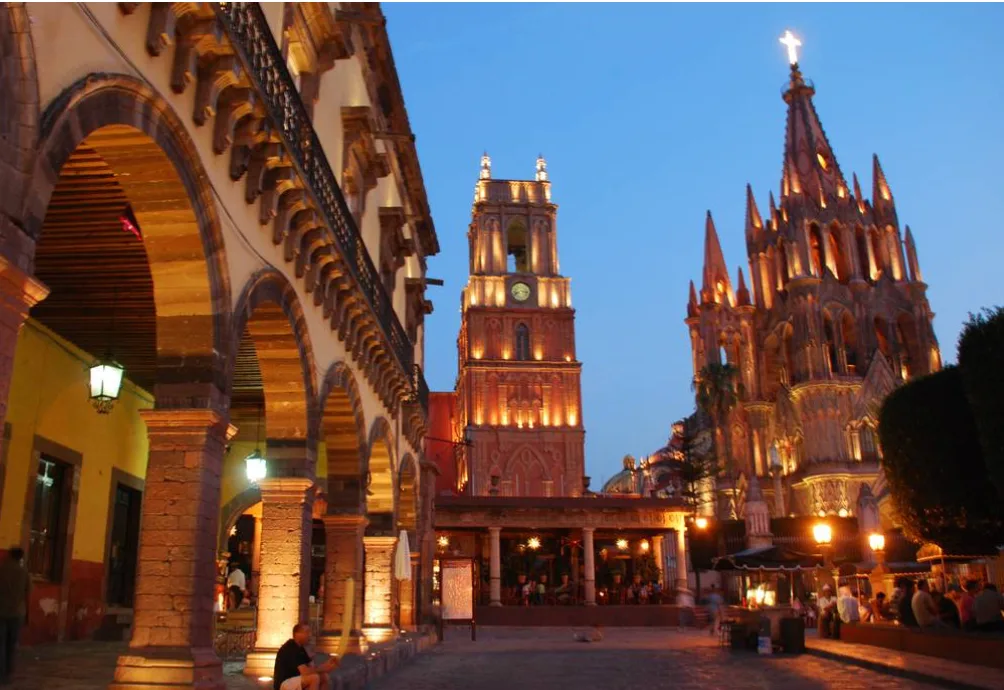
The president of the San Miguel de Allende Hotel Association, Jorge Olalde Chávez, pointed out that the growth of short-term rental platforms like Airbnb has made the municipality one of the most important markets in the country for this type of accommodation, but it has also highlighted the lack of state mechanisms for collecting taxes and regulating an activity that directly competes with traditional hotels.
In an interview, the industry representative explained that the rise in vacation rentals is linked to the municipality’s real estate growth and the purchase of properties by people seeking to generate additional income by renting out houses, apartments, or rooms.
“San Miguel de Allende is in the spotlight because this occupancy model already existed not only on Airbnb but also on other platforms. Given the type of destination and the type of residents and visitors, it was an opportunity to rent properties for short or long stays,” he commented.
He also noted that the phenomenon has strengthened in recent years due to the popularity of digital platforms and the interest of national and foreign investors in acquiring properties in tourist destinations.

Olalde Chávez asserted that there is currently a very similar supply of hotel rooms and spaces available on short-term rental platforms within the municipality. Although he acknowledged that digital platforms are part of a new reality in the tourism market, he believes that state authorities have been negligent in establishing a system that allows for equitable tax contributions.
“In San Miguel, there are between 3,500 and 3,600 hotel rooms available, and we always estimated that there was one Airbnb room for every hotel room. Today, the figures are practically the same. Electronic platforms are now an everyday tool. The same is true for Uber in transportation as for Airbnb in lodging. What is needed is to properly regulate their operation,” he stated.
The leader maintained that while at the federal level there is a system in place for platforms to report operations and pay taxes to the Tax Administration Service (SAT), in Guanajuato, the collection of the Lodging Tax, which hotels do pay, remains pending.
“At the federal level, there is already extraordinary revenue generated from electronic platforms, but at the state level, we are among the most vulnerable because there are no agreements or efficient mechanisms for collecting this tax,” he stated.
He explained that the state tax is equivalent to 4 percent of room rentals and currently constitutes one of the main sources of funding for tourism promotion in Guanajuato. Therefore, the hotelier asserted that the lack of agreements between the Finance Ministry, the Legal Counsel, and the digital platforms has prevented these resources from reaching the state, despite the market’s sustained growth.
“All the tourism promotion work of the Ministry of Tourism is supported by the lodging tax. However, all the lodging sold through electronic platforms is not generating income for the state. There is a very significant potential revenue that is not reaching Guanajuato. We are talking about resources that could be allocated to promotion, tourism infrastructure, or social programs,” he said.
Finally, the businessman noted that the hotel association has been holding meetings with state authorities for over a decade to address the issue, without a solution being reached so far.
“We’re tired of meeting with authorities, with Secretaries of Tourism, with Finance officials, and with the platforms themselves. What’s lacking is the will to implement a working model,” he stated.
Source: es-us.noticias.yahoo