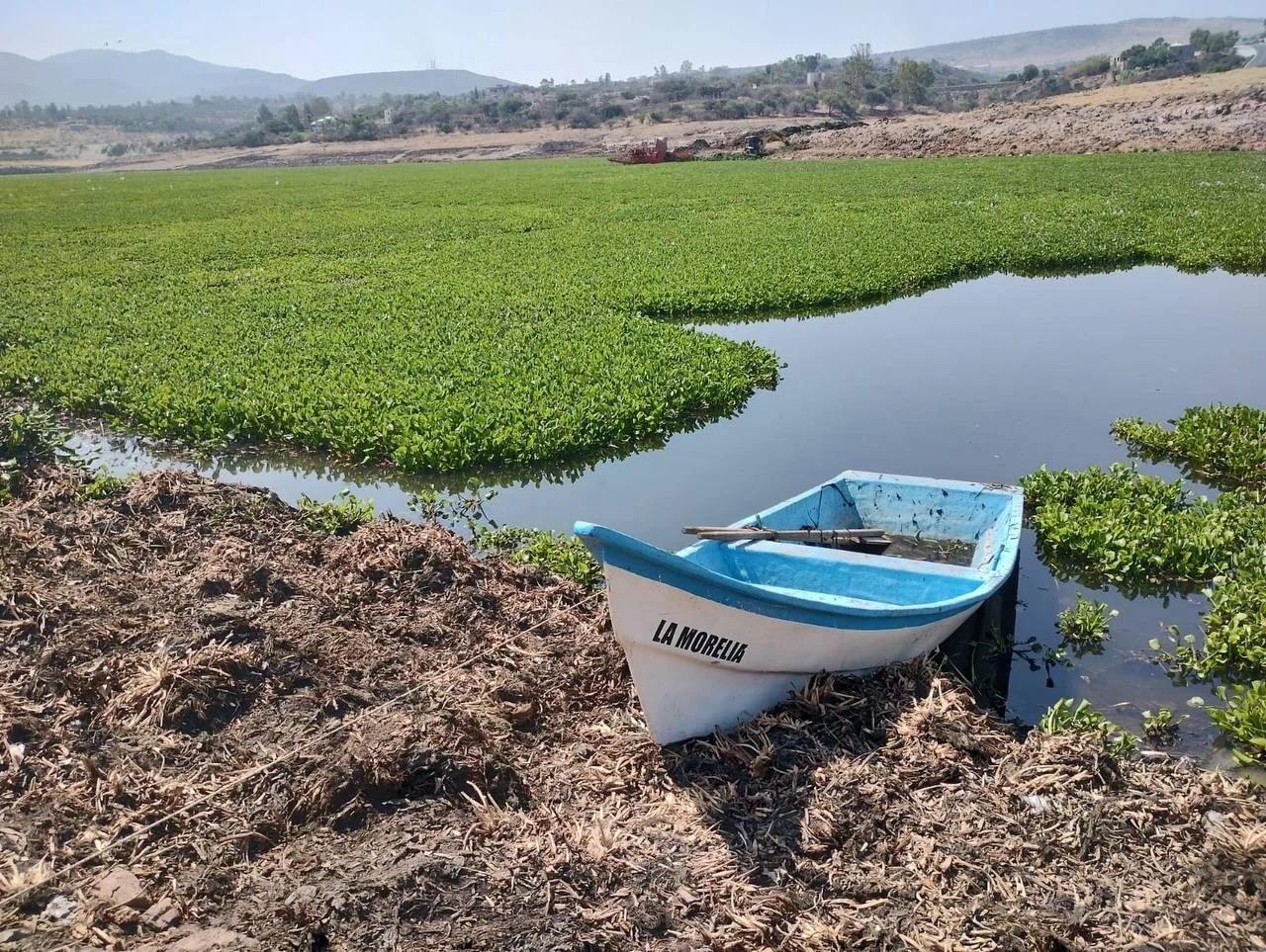
The Municipal President of San Miguel de Allende, Mauricio Trejo Pureco, noted that—despite the efforts undertaken by the three levels of government at the Allende Dam—they are barely managing to win the battle regarding the containment of the water hyacinth. He explained that eradicating the infestation will require additional machinery, resources, and manpower, as well as investment in cleaning the Río Laja basin; consequently, the problem will not be resolved in the short term.
The San Miguel mayor pointed out that for a little over a month—since CONAGUA (the National Water Commission) decided to address the persistent issues plaguing the reservoir for more than five years—his administration has placed itself at the disposal of the federal agency, which is spearheading the cleanup operations.
The mayor noted that the plant’s growth will continue as long as contaminated water persists within the regional basin. “They are working every day; the municipality is working every day. We continue to combine our efforts, which is the only way we will manage to make even a slight dent in the water hyacinth problem,” he emphasized.
Water Hyacinth Containment Advances, but Eradication Does Not
However, while acknowledging that current efforts are succeeding in containing the spread of the infestation, he noted that it is still far from being eradicated.
“We are currently in the season when the water hyacinth reproduces at a rate of three-to-one every day; a single plant generates three new ones due to the heat, humidity, and nutrients present in the dam,” stated the mayor. He further stressed that the water hyacinth infestation is not solely the fault of San Miguel de Allende, but rather the result of the cumulative inflow of contaminated water arriving from various municipalities.
The mayor of San Miguel warned that containing the infestation requires additional machinery, resources, and sanitation efforts within the Río Laja basin. Mauricio Trejo Pureco stated that, while it can currently be said that containment has been achieved, the complete elimination of the infestation will require significantly more resources. “I believe we are making progress in the battle for containment; today, we have the capacity to contain the water hyacinth in the Allende Dam. The next step—which no longer falls under the municipality’s purview—is to increase our capacity in terms of machinery, biological agents, and manpower to take the subsequent step: focusing specifically on reducing the hyacinth,” he said.
In addition to the resources allocated for extracting the plant from the dam, the municipal president noted that it would be necessary to construct at least five large-scale water treatment plants throughout the river basin. The goal would be to eradicate the pollutants that serve as a food source for the infestation—an undertaking that would require tens of millions of pesos—leading him to conclude that the problem will not be resolved in the short term.
“It is highly unlikely that, within the next 10 years, we will see a Laja River devoid of the nutrients necessary for the water hyacinth to grow. Therefore, the issue of the water hyacinth is a problem that has arrived—and, unfortunately, it is here to stay, at least for the medium term,” he said.