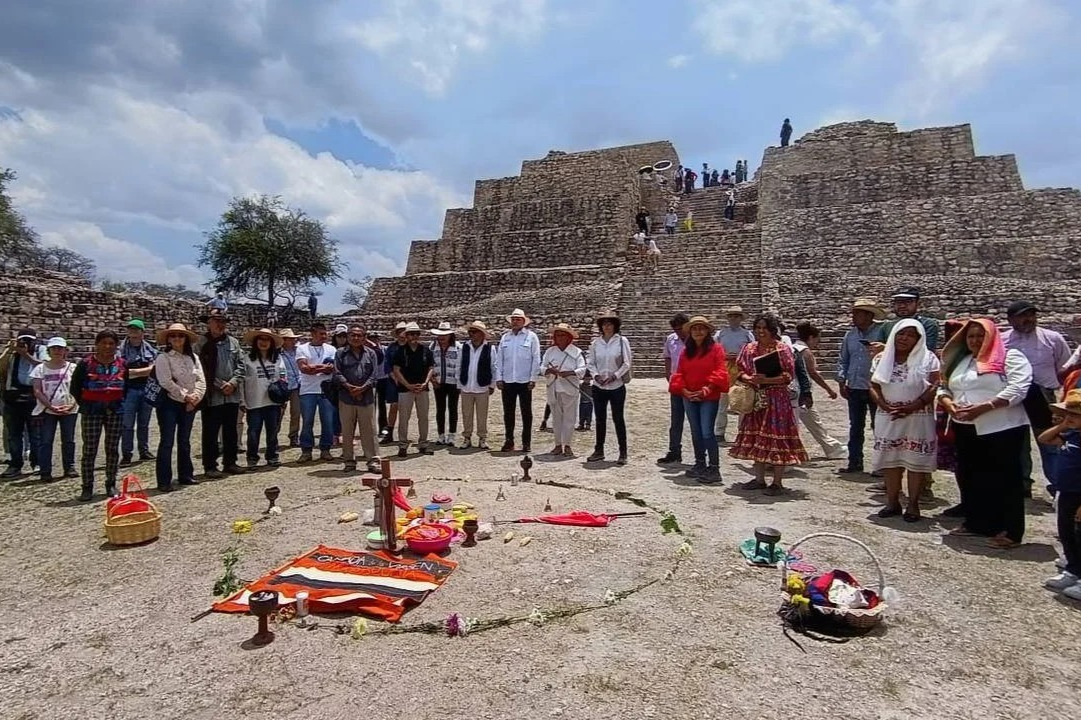
Four months after closing to the public, the archaeological site of Cañada de la Virgen reopened with a traditional ceremony in which representatives of Indigenous communities celebrated the recovery of the space and honored the archaeologists who began the restoration project in the 1980s.
Still under the protection of the Guardia Nacional, federal and state authorities attended the reopening of the ceremonial center alongside members of Indigenous communities from San Miguel de Allende, San Luis de la Paz, and Comonfort. They were welcomed by the caretakers of Cañada de la Virgen, who led prayers to the four winds and blessed the site.
During the event, Indigenous representatives especially thanked Jesusa Rodríguez for helping achieve the reopening of the archaeological zone, which they consider an important historical and ceremonial place belonging to Indigenous peoples.
Carmen Álvarez, a representative of the National Institute of Indigenous Peoples, stated:
“Here we are, the true owners of these spaces, the Indigenous communities who were dispossessed and denied access. Never again a Mexico without us, never again a San Miguel without the people of San Miguel and without Indigenous peoples.”
Visitors climbed the main pyramid, where they paid tribute to “La Jerarca” at the highest point and later placed offerings in the sunken patio. A ceremony also honored Luis Felipe Nieto, the first archaeologist who requested the preservation of the site and estimated that it covered around 700 hectares. After part of the land was donated in 2000, he was reportedly expelled from the area as part of an agreement between authorities and the property owner.
The event also commemorated Gabriela Zepeda, who worked on the research and restoration of Cañada de la Virgen for the past 25 years.
The reopening became possible after the completion of the expropriation process of 701 hectares, declared to be for public use after authorities learned of plans to build at least 100 luxury homes overlooking the archaeological remains. According to National Institute of Anthropology and History director Joel Omar Vázquez Herrera, compensation for the expropriation exceeded 71 million pesos.
Federal authorities stated that although the legal process is finished, the area will continue to be guarded by the National Guard to prevent disputes with former landowners, who recently issued public statements despite not responding to authorities during the previous four years.
Jesusa Rodríguez explained that, legally, the expropriation can no longer be challenged because the only possible objection would have been the compensation amount, and the deadline to dispute it has already passed.
She also claimed that the owners originally controlled more than 5,000 hectares of land and still retain about 4,300 hectares, which she described as illegally held because they form what she called the last large estate (“latifundio”) in San Miguel de Allende.
Finally, Rodríguez noted that authorities must now work on agreements to guarantee access routes for nearby ejidos, communities, and rural settlements surrounding the archaeological site.